


Teaching kids to save money is one of the most valuable life skills parents can impart. In a world where instant gratification is everywhere, helping children understand the basics of financial responsibility builds a foundation for lifelong success. Whether you’re dealing with a toddler’s first piggy bank or a tween’s allowance, knowing how to teach kids to save money can make the process fun and effective. This guide explores practical strategies, from setting savings goals to teaching delayed gratification, all designed to make “teaching kids how to save money” a natural part of family life.
By starting early, parents can show children that saving isn’t just about hoarding coins—it’s about making smart choices for the future. According to experts from Ramsey Solutions and NerdWallet, kids who learn to save money develop better decision-making skills, empathy, and self-control. Let’s dive into 25 expert tips, including the 3-jar method and other proven techniques, to help you teach your kids to save money effectively.
Understanding the Basics: What Is Money, and Why Save It?
Before diving into how to teach kids to save money, explain the fundamentals. Start with “What is money for kids?” Money is a tool we use to buy things we need and want. It’s earned through work or gifts and can grow if saved wisely.
- Show Them How Money Works: Use play money or real coins to demonstrate exchanges. For example, pretend to “buy” a snack from a toy store. This helps kids see money as limited, introducing scarcity.
- Teach Budgeting Basics to Kids: Break down income (allowance or gifts) into categories. Explain that not all money can be spent immediately—some must be saved for later.
- Make a Habit of Saving: Encourage daily or weekly routines, like adding coins to a jar after chores. This turns saving into a positive habit.

Setting Savings Goals: The Foundation of Smart Saving
Setting savings goals gives kids a clear purpose, making “how to teach kids to save money” ideas more motivating.
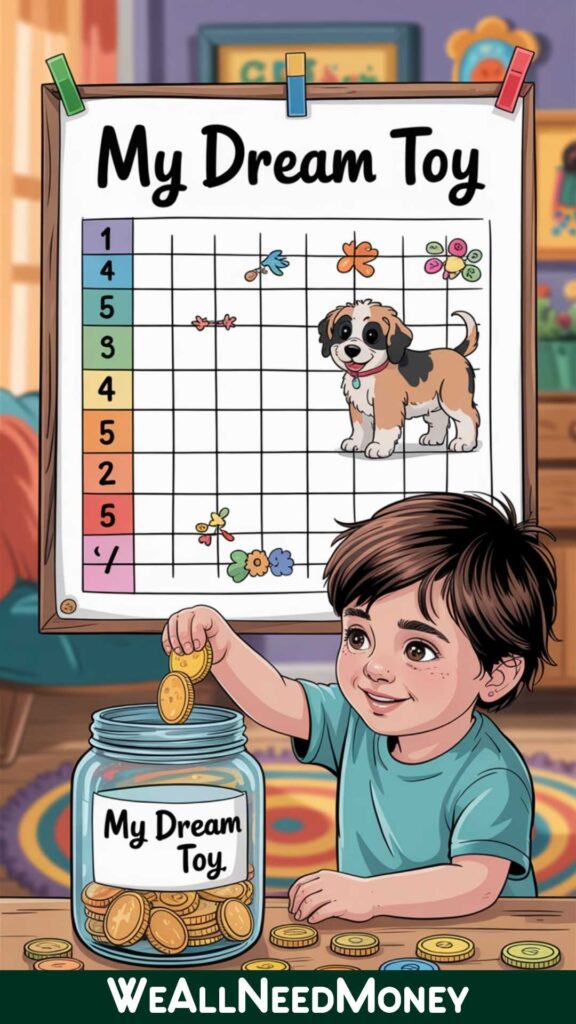
- Set Savings Goals for Kids: Help them choose achievable targets, like saving for a toy. Use a chart to track progress visually.
- Establish Saving Objectives: For older kids, tie goals to long-term dreams, such as a bike or trip. This teaches foresight.
- Challenge Your Child to Save More: Turn it into a game—match their savings dollar for dollar up to $10. This boosts excitement.
According to a study from the FDIC, kids who set goals save more consistently. Start small: A 9-year-old can aim to save $5 a week from allowance.
Needs vs Wants: Prioritizing Essentials
A key part of “teach kids how to save money” is distinguishing between necessities and desires.
- Needs vs. Wants for Kids: Explain needs (food, shelter) vs. wants (toys, candy). Use examples: “We need dinner, but ice cream is a want.”
- Opportunity Cost for Kids: Show that choosing one thing means giving up another. “If you buy candy now, you can’t save for that game later.”
- Teach Delayed Gratification to Kids: Practice waiting for rewards. For instance, save for a week to earn a treat, building patience.
Resources like PBS LearningMedia offer free games on needs vs. wants to make learning interactive.
Practical Tools: Piggy Banks, Jars, and Accounts
Hands-on tools make “how I teach my kids to save money” tangible.
- Start a Piggy Bank for Kids: Begin with a clear piggy bank so they see money grow. Amazon has fun options like this piggy bank for kids (affiliate link—earn a small commission at no extra cost to you), perfect for visual learning.
- Use Savings Jars for Kids: Try the 3-jar method: Label jars “Save,” “Spend,” and “Give.” Divide allowance equally to teach allocation.
- Open a Savings Account for Kids: For ages 6+, set up a kids’ savings account like Greenlight (affiliate link—Greenlight, offering up to $10 per referral). It earns interest and teaches banking.
The 3-jar method, popularized by Fulton Bank, is a simple way to introduce budgeting.

Earning and Allowing: Building Responsibility
- Earn Allowance for Doing Chores: Pay for age-appropriate tasks like cleaning rooms. This shows money comes from effort.
- Earn More Money for Kids: Encourage small jobs, like lemonade stands, to teach entrepreneurship.
- Provide Rewards for Saving Money: Match savings (e.g., add $1 for every $5 saved) to incentivize.
Teaching Concepts: Value, Gratification, and Giving
- How to Teach Kids the Value of Money: Discuss earning through work. Use games like Monopoly to simulate choices.
- Show Them How Money Works: Visit a bank or use apps to explain interest. For example, Acorns (earn $5 per referral) grows small investments.
- Teach Delayed Gratification to Kids: Practice waiting, like saving for a week before buying candy.
- Encourage Giving for Kids: Set aside money for charity, teaching empathy.
- Offer Incentives to Save Money: Reward milestones, like a family outing for reaching $50 saved.
Involving Family and Advanced Lessons
- Involve Children in Family Money Management: Discuss household budgets (anonymously) to show real-world application.
- Talk About Money with Kids: Have open conversations about costs, avoiding taboo.
- Leave Room for Mistakes in Money Lessons: Allow small errors, like overspending allowance, to learn consequences.
- Explain Investments to Kids: Simplify: “Investing is like planting a seed—it grows over time.” Start with apps like Acorns Junior (Acorns Junior earns commissions on family sign-ups).
- Challenge Your Child to Save More: Run family savings challenges, like “No-Spend Week,” to make it fun.
By incorporating these strategies, parents can make “how to teach your kids to save money” a positive experience. Remember, the goal is building habits that last a lifetime.
How to Set Savings Goals for Kids
– Help your child choose an achievable target, like a toy.
– Create a visual chart to track progress.
– Divide allowance into save/spend/give jars.
– Celebrate when the goal is reached.”
Frequently Asked Questions
How to teach your kids to save money?
Start with basics like piggy banks and needs vs. wants, then move to goals and allowances. Use tools like the 3-jar method for hands-on learning.
What is the 3-jar method?
It’s a budgeting system where kids divide money into three jars: Save, Spend, and Give. This teaches allocation and generosity, as explained by Fulton Bank.
How to teach kids the value of money?
Use real-life examples, like earning allowance for chores, to show money comes from effort. Games and discussions help reinforce needs vs. wants.
How can a 9-year-old save money?
A 9-year-old can use a piggy bank, earn allowance for chores, and set small goals like saving for a game. Apps like Greenlight (affiliate link—Greenlight) make it fun with parental controls.
Conclusion
Teaching kids to save money doesn’t have to be complicated—it’s about consistent, fun lessons that build habits. From starting a piggy bank to explaining investments, these 25 tips provide a roadmap for parents. Encourage giving, involve family in money management, and offer incentives to save money, and you’ll see your child grow into a financially savvy adult. For more “how to teach kids to save money” ideas, check out family budgeting tools like YNAB (affiliate link—YNAB, earns commissions on referrals) or children’s books on money from Amazon (affiliate link—Amazon children’s money books, small commission at no extra cost). Start today—your child’s future self will thank you.