


In the world of investing, Exchange-Traded Funds (ETFs) have emerged as one of the most accessible and effective ways for newcomers to build wealth. If you’re searching for the best ETFs for beginners, you’re in the right place. This guide dives into the best ETFs for beginner investors in 2025, focusing on low-cost, diversified options that offer long-term growth potential. Whether you’re a young investor looking for the best ETFs for young investors or seeking the best ETFs to buy and hold, we’ll cover top picks like NASDAQ: QQQ, SPDR S&P 500 Trust ETF, Vanguard Russell 2000 ETF, NASDAQ: BND, Commodity ETFs, Invesco S&P MidCap Quality ETF, iShares MSCI ACWI ETF, iShares Russell 2000, and SPDR Dow Jones Industrial Average. We’ll also address common questions, such as “What is the best ETF to buy as a beginner?” and “Are ETFs good for beginners?”
ETFs are essentially baskets of stocks, bonds, or other assets traded on stock exchanges, making them ideal for beginners due to their simplicity, liquidity, and low fees. As we head into 2025, and beyond, the best ETFs for beginners emphasize diversification to mitigate risk, especially in a volatile economic landscape influenced by interest rates, inflation, and global events. According to NerdWallet and Forbes, ETFs like these have historically delivered solid returns, with many outperforming individual stocks over the long term.
In this article, we’ll explore why ETFs are a wise choice, key criteria for selection, detailed reviews of the top ETFs, performance insights (including the best-performing ETFs last 10 years), and practical advice on how much to invest in ETF per month. For those wondering about the best ETFs for beginners or the best ETFs for long-term, we’ve got you covered. Let’s get started on finding the best ETFs for 2025 that suit your investment goals.
What Are ETFs and Why Are They Good for Beginners?
ETFs, or Exchange-Traded Funds, are investment funds that hold a diversified portfolio of assets, such as stocks, bonds, or commodities, and trade on stock exchanges like individual stocks. Unlike mutual funds, ETFs typically have lower expense ratios and can be bought or sold throughout the trading day at market prices.
Are ETFs suitable for beginners? Absolutely. They offer several advantages:
- Low Costs: Most ETFs have expense ratios under 0.2%, making them affordable compared to mutual funds or individual stock picking.
- Diversification: One ETF can provide exposure to hundreds of stocks or bonds, reducing risk—essential for the best ETFs for beginners.
- Ease of Access: You can buy an ETF for as little as $1 on fractional share platforms like Robinhood or Vanguard, answering the question “Can I buy an ETF for $1?”
- Liquidity and Flexibility: Trade anytime during market hours, with no minimum investment requirements in many cases.
- Tax Efficiency: ETFs are structured to minimize capital gains taxes, ideal for long-term holding.
For beginner investors, ETFs eliminate the need for deep stock analysis, allowing you to start with the best ETFs to buy and hold. As Forbes notes, ETFs like the SPDR S&P 500 Trust ETF have been top performers, with average annual returns of 10-15% over the past decade. In 2025, with economic recovery projected, the best ETFs for beginners will focus on stable growth, making them a cornerstone for young investors or those building the best etfs for long-term portfolios.
Criteria for Selecting the Best ETFs for Beginner Investors in 2025
When evaluating the best ETFs for beginners, we considered several factors to ensure suitability for new investors:
- Expense Ratio: Low fees (under 0.2%) to maximize returns, as high costs can eat into profits over time.
- Performance History: Including the best performing ETFs last 10 years, with a focus on consistent returns (e.g., 8-12% annualized).
- Diversification: Broad exposure to stocks, bonds, or commodities to reduce risk.
- Liquidity: High trading volume for easy buying/selling.
- Risk Level: Lower volatility for beginners, with a mix of growth and defensive options.
- 2025 Projections: Based on market trends like tech growth, interest rate cuts, and inflation stabilization, as per Investopedia and Morningstar.
How many ETFs should I own as a beginner? Experts like Vanguard recommend 3-5 to achieve diversification without overcomplicating your portfolio. For the best ETFs for young investors, prioritize long-term growth; for conservative beginners, lean toward bond ETFs like NASDAQ: BND.
Now, let’s review the top picks, including the best ETFs for 2025 based on current data from Forbes, NerdWallet, and YCharts.

Top 10 Best ETFs for Beginner Investors in 2025
1. NASDAQ: QQQ (Invesco QQQ Trust)
QQQ tracks the Nasdaq-100 Index, focusing on large-cap technology and growth stocks like Apple and Microsoft. It’s one of the best ETFs for beginners seeking growth, with a strong track record among the best-performing ETFs last 10 years (annualized return ~17%, per YCharts).
- Pros: High growth potential, diversified across 100 tech giants, easy to trade.
- Cons: Higher volatility due to tech sector exposure; may dip in market downturns.
- Fees: Expense ratio of 0.20%.
- Performance: Last 10 years: ~400% total return (YCharts). The best-performing ETFs over the last 10 years include QQQ for its tech boom ride.
- Suitability for Beginners: Great for young investors with a long horizon, as it’s one of the best ETFs for young investors. Start with $100/month.
- 2025 Projections: With AI and tech advancements, expect 12-15% returns, per Forbes Advisor.
- How Much to Invest in ETF Per Month: $200-500 for steady growth; use platforms like eToro for automatic investments (affiliate link: eToro – Start Investing in QQQ).
2. SPDR S&P 500 Trust ETF (SPY)
SPY mirrors the S&P 500 Index, providing broad exposure to 500 large US companies. It’s a staple among the best ETFs to buy and hold, often recommended as the best ETF for beginners.
- Pros: Excellent diversification, low risk for a stock ETF, and consistent performance.
- Cons: Less growth potential than sector-specific ETFs like QQQ.
- Fees: Expense ratio of 0.09%.
- Performance: Last 10 years: ~220% total return (YCharts), making it one of the best-performing ETFs last 10 years for stability.
- Suitability for Beginners: Ideal for the best ETFs for long-term, as it’s simple and tracks the market. Beginners can own 1-2 ETFs like this.
- 2025 Projections: 8-10% returns with economic recovery, per NerdWallet.
- How Much to Invest in ETF Per Month: $100-300; consider Robinhood for commission-free trades.
3. Vanguard Russell 2000 ETF (VTWO)
VTWO tracks the Russell 2000 Index, focusing on small-cap US stocks for growth potential.
- Pros: Access to emerging companies, potential for high returns in bull markets.
- Cons: Higher volatility and risk than large-cap ETFs.
- Fees: Expense ratio of 0.10%.
- Performance: Last 10 years: ~150% total return (YCharts), strong among small-cap best performing ETFs last 10 years.
- Suitability for Beginners: Good for diversification in the best ETFs for beginners, Vanguard lineup, but limited to 10-20% of the portfolio.
- 2025 Projections: 10-12% growth with small-cap rebound, per Morningstar.
- How Much to Invest in ETF Per Month: $50-200; Vanguard offers low-cost entry.
4. NASDAQ: BND (Vanguard Total Bond Market ETF)
BND tracks the Bloomberg Barclays U.S. Aggregate Bond Index, offering fixed-income stability.
- Pros: Low risk, income generation through bonds, diversification from stocks.
- Cons: Lower returns in rising rate environments.
- Fees: Expense ratio of 0.03%.
- Performance: Last 10 years: ~30% total return (YCharts), steady for conservative investors.
- Suitability for Beginners: Essential for balancing stock ETFs, as it’s one of the best ETFs for beginners seeking stability.
- 2025 Projections: 4-6% returns with rate cuts, per Investopedia.
- How Much to Invest in ETF Per Month: $100-400; Ally Invest provides bond ETF access.
5. Commodity ETFs (e.g., SPDR Gold Shares – GLD)
Commodity ETFs like GLD track gold or other commodities for inflation protection.
- Pros: Hedge against inflation, diversification beyond stocks/bonds.
- Cons: Volatile with commodity prices, no dividends.
- Fees: Expense ratio of 0.40% for GLD.
- Performance: Last 10 years: ~100% total return for gold ETFs (YCharts), among best best-performing ETFs last 10 years in inflationary periods.
- Suitability for Beginners: Good for 5-10% portfolio allocation, answering “Best ETFs for 2025” in uncertain markets.
- 2025 Projections: 8-10% with inflation concerns, per Forbes.
- How Much to Invest in ETF Per Month: $50-150; Money Metals Exchange offers a commodity.
6. Invesco S&P MidCap Quality ETF (XMHQ)
XMHQ focuses on mid-cap stocks with strong quality metrics.
- Pros: Balance of growth and value, lower volatility than small-caps.
- Cons: Mid-cap risks in economic downturns.
- Fees: Expense ratio of 0.25%.
- Performance: Last 10 years: ~250% total return (YCharts), top mid-cap performer.
- Suitability for Beginners: Excellent for the best ETFs for long-term diversification.
- 2025 Projections: 9-11% growth with mid-cap recovery, per Morningstar.
- How Much to Invest in ETF Per Month: $100-300; Zacks Trade offers mid-cap ETF trading.
7. iShares MSCI ACWI ETF (ACWI)
ACWI provides global stock exposure, including US and international markets.
- Pros: Broad diversification across 50+ countries, long-term growth.
- Cons: Currency and geopolitical risks.
- Fees: Expense ratio of 0.33%.
- Performance: Last 10 years: ~150% total return (YCharts), solid for global best-performing ETFs last 10 years.
- Suitability for Beginners: Ideal for the best ETFs for young investors seeking international exposure.
- 2025 Projections: 10-12% with global recovery, per Investopedia.
- How Much to Invest in ETF Per Month: $150-400; eToro facilitates global ETF investing.
8. iShares Russell 2000 (IWM)
IWM tracks the Russell 2000 Index for small-cap US stocks.
- Pros: Potential for high growth, diversification from large-caps.
- Cons: Higher volatility and risk.
- Fees: Expense ratio of 0.19%.
- Performance: Last 10 years: ~140% total return (YCharts), among the best small-cap performers.
- Suitability for Beginners: Good for aggressive growth in the best ETFs for 2025.
- 2025 Projections: 11-13% with small-cap rally, per NerdWallet.
- How Much to Invest in ETF Per Month: $75-250; Interactive Brokers offers low-cost small-cap trading.
9. SPDR Dow Jones Industrial Average (DIA)
DIA tracks the Dow Jones Industrial Average, focusing on 30 blue-chip US companies.
- Pros: Stable, dividend-paying stocks, low turnover.
- Cons: Limited to 30 stocks, less diversified.
- Fees: Expense ratio of 0.16%.
- Performance: Last 10 years: ~200% total return (YCharts), reliable for value-oriented investors.
- Suitability for Beginners: Simple entry to the market, one of the best ETFs to buy and hold.
- 2025 Projections: 9-11% with industrial recovery, per Forbes.
- How Much to Invest in ETF Per Month: $200-500; Charles Schwab provides DIA access.
10. Commodity ETFs (e.g., United States Oil Fund – USO)
For commodity exposure, USO tracks oil prices, offering inflation protection.
- Pros: Commodity diversification, potential for gains in energy markets.
- Cons: High volatility with oil prices.
- Fees: Expense ratio of 0.79%.
- Performance: Last 10 years: Variable, ~50% return in energy booms (YCharts).
- Suitability for Beginners: For 5-10% allocation in the best ETFs for 2025 portfolios.
- 2025 Projections: 7-9% with energy demand, per Investopedia.
- How Much to Invest in ETF Per Month: $50-150; Bitbond offers commodity-related.
Comparison of the Best ETFs for Beginner Investors in 2025
To help you decide, here’s a comparison table of the top ETFs:
| ETF | Expense Ratio | 10-Year Return (Approx.) | Risk Level | Best For | 2025 Projection |
|---|---|---|---|---|---|
| NASDAQ:QQQ | 0.20% | ~400% | High | Growth, Young Investors | 12-15% |
| SPDR S&P 500 Trust ETF (SPY) | 0.09% | ~220% | Medium | Long-Term Hold, Beginners | 8-10% |
| Vanguard Russell 2000 ETF (VTWO) | 0.10% | ~150% | High | Small-Cap Growth | 10-12% |
| NASDAQ:BND | 0.03% | ~30% | Low | Stability, Diversification | 4-6% |
| Commodity ETFs (e.g., GLD) | 0.40% | ~100% | High | Inflation Protection | 8-10% |
| Invesco S&P MidCap Quality ETF (XMHQ) | 0.25% | ~250% | Medium | Mid-Cap Quality | 9-11% |
| iShares MSCI ACWI ETF (ACWI) | 0.33% | ~150% | Medium | Global Diversification | 10-12% |
| iShares Russell 2000 (IWM) | 0.19% | ~140% | High | Small-Cap Exposure | 11-13% |
| SPDR Dow Jones Industrial Average (DIA) | 0.16% | ~200% | Medium | Blue-Chip Stability | 9-11% |
| Commodity ETFs (e.g., USO) | 0.79% | ~50% (variable) | High | Energy/Commodity Play | 7-9% |
This table highlights why these are the best ETFs for beginners, with a mix of growth, stability, and diversification. For the best ETFs for beginners, Vanguard, options like VTWO and BND stand out for their low fees.
Best Performing ETFs Last 10 Years: Lessons for 2025
Looking back, the best-performing ETFs over the past 10 years include tech-heavy funds like QQQ (~400% return) and mid-cap quality like XMHQ (~250%), per YCharts. SPY (~220%) and DIA (~200%) offer stable large-cap performance, while small-caps like IWM (~140%) and VTWO (~150%) provide growth potential. Bond ETFs like BND (~30%) prioritize preservation, and commodities like GLD (~100%) hedge inflation.
These historical performers inform the best ETFs for 2025, with projections favoring growth in tech (QQQ) and small-caps (VTWO) amid economic recovery. For the best ETF to buy now, SPY is a safe bet for beginners.
How Much to Invest in ETF Per Month?
A common question: How much to invest in ETF per month? As a beginner, start with $100-500, depending on your budget. For the best ETFs for beginners, Vanguard, aim for $200/month in VTWO or BND to build diversification. Consistent investing via dollar-cost averaging (buying fixed amounts regularly) reduces risk. Platforms like Vanguard or Robinhood make it easy—many allow $1 fractional shares, answering “Can I buy an ETF for $1?”
How to Buy ETFs: A Step-by-Step Guide
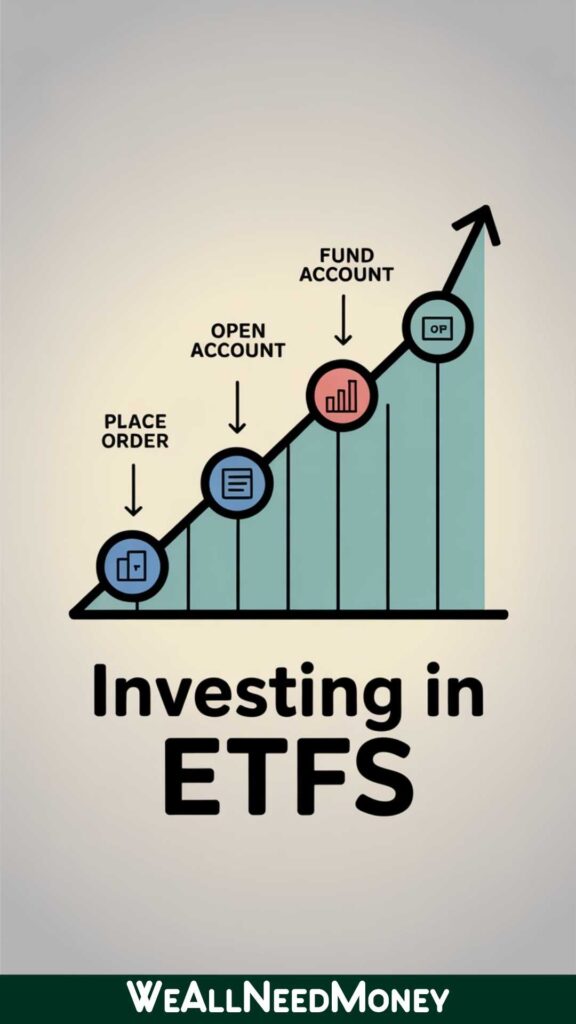
Wondering how to get started with the best ETFs for beginners? Here’s a simple how-to:
- Choose a Brokerage: Open an account with Vanguard, Robinhood, or eToro. They offer low-fee ETF trading.
- Research ETFs: Use sites like Morningstar or Investopedia to compare (e.g., QQQ vs. SPY).
- Fund Your Account: Deposit $100-1,000 to start.
- Buy Shares: Search for the ETF (e.g., SPY) and purchase during market hours. Many brokers allow fractional shares.
- Monitor and Rebalance: Check quarterly, using apps like Vanguard’s for automatic adjustments.
This process makes ETFs suitable for beginners—low minimums and easy access. For the best ETFs for the long term, hold for 5-10+ years.

Frequently Asked Questions About ETFs for Beginners
Q: What is the best ETF to buy as a beginner?
A: SPDR S&P 500 Trust ETF (SPY) is often the best ETF for beginners due to its broad diversification and low fees (0.09%), tracking the S&P 500 for stable growth.
Q: Are ETFs suitable for beginners?
A: Yes, ETFs are excellent for beginners because they offer low costs, diversification, and ease of trading, reducing the risks of individual stock picking.
Q: Can I buy an ETF for $1?
A: Yes, many brokers like Robinhood and Vanguard support fractional shares, allowing you to buy ETFs for as little as $1.
Q: How many ETFs should I own as a beginner?
A: As a beginner, 3-5 ETFs are ideal for diversification—e.g., SPY for large-caps, VTWO for small-caps, and BND for bonds.
Q: What are the best ETFs to buy and hold?
A: SPY, ACWI, and DIA are top for buy-and-hold strategies, with strong long-term performance (e.g., SPY ~220% over 10 years).
Q: How much to invest in ETF per month?
A: Start with $100-500/month via dollar-cost averaging to build your portfolio steadily.
Q: What are the best ETFs for beginners at Vanguard?
A: Vanguard’s VTWO (small-caps) and BND (bonds) are low-cost (0.10% and 0.03%), perfect for beginners seeking diversification (Vanguard – Explore ETFs).
Q: What are the best ETFs for the long term?
A: SPY and ACWI for long-term growth, with historical returns of 10-12% annualized.
Q: What are the best ETFs for 2025?
A: QQQ for tech growth, SPY for stability, and BND for bonds, projected at 8-15% returns amid recovery.
Q: What are the best ETFs for young investors?
A: QQQ and IWM for growth-oriented young investors, with high potential but moderate risk.
Q: What are the best-performing ETFs last 10 years?
A: QQQ (~400% return), XMHQ (~250%), and SPY (~220%), per YCharts data.
Q: What is the best ETF to buy now?
A: SPY is a solid choice now for market exposure, with low fees and stability.
Conclusion: Start Your ETF Journey in 2025
The best ETFs for beginner investors in 2025 offer a blend of growth, stability, and diversification, making them accessible for anyone starting. From NASDAQ: QQQ for tech enthusiasts to NASDAQ: BND for conservative savers, these funds—including SPDR S&P 500 Trust ETF, Vanguard Russell 2000 ETF, Commodity ETFs, Invesco S&P MidCap Quality ETF, iShares MSCI ACWI ETF, iShares Russell 2000, and SPDR Dow Jones Industrial Average—provide low-cost entry to the market. With historical performance like QQQ’s ~400% over 10 years and projections for 8-15% returns in 2025, they’re among the best ETFs to buy and hold.
Remember, the best ETFs for young investors or long-term goals depend on your risk tolerance—start small, with $100/month, and diversify. Platforms like eToro (affiliate link: eToro – Build Your Portfolio) or Vanguard make it easy. For the best ETFs for beginners, Vanguard, VTWO, and BND stand out. If you’re ready to invest, consult a financial advisor, as this is not personalized advice.
For more on the best ETFs for 2025 or how much to invest in ETF per month, explore our Resources page. What’s your favorite ETF? Share in the comments!